Weeks before the deadline, set by Union Home Minister Amit Shah for the elimination of Maoist insurgency from Chhattisgarh and the country, a significant development unfolded in Bastar on Wednesday with the surrender of 108 Maoist cadres before security forces in Jagdalpur, marking one of the largest collective surrenders in the region in recent years. The development is being seen as a significant setback for the insurgent network in its long time stronghold.
The cadres, belonging to the Dandakaranya Special Zonal Committee (DKSZC) of the Maoist movement, surrendered under the state government’s “Poona Margaem-Rehabilitation to Rejuvenation” initiative, choosing to abandon violence and rejoin the mainstream.
Advertisement
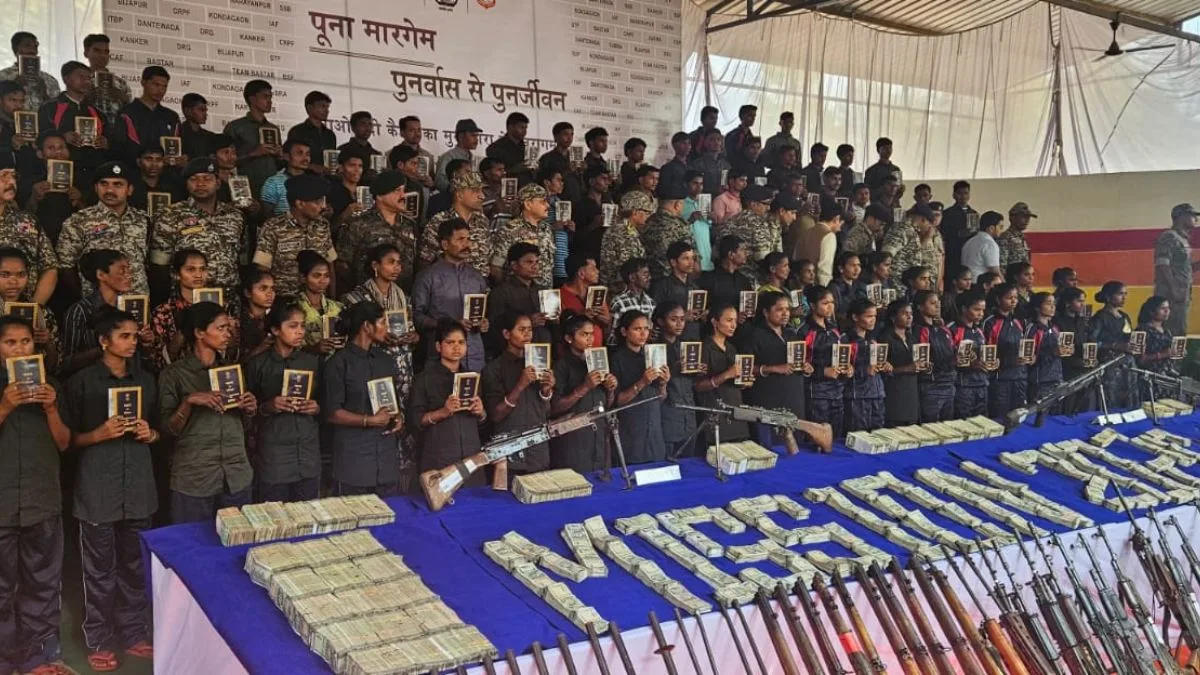
The group comprised 64 male and 44 female cadres, collectively carrying a bounty of ₹3.29 crore. The surrender ceremony was held at the Bastar divisional headquarters in Jagdalpur in the presence of Chhattisgarh Director General of Police Arun Dev Gautam, Additional Director General Vivekanand Sinha, Bastar Inspector General Sundarraj P, and senior officers of the CRPF, BSF and district police.
During the programme, security agencies also showcased a large cache of arms surrendered by the cadres. Officials said the Maoists deposited 101 weapons, including seven AK-47 rifles, 10 INSAS rifles, five SLR rifles, four light machine guns (LMGs), 20 .303 rifles and 11 BGL launchers, along with other arms and ammunition. Authorities described the recovery as one of the largest weapon handovers associated with a collective Maoist surrender in Bastar.
Security forces also displayed a massive dump of materials seized during recent operations across the Bastar range. According to officials, the recovered items included ₹3.61 crore in cash and nearly one kilogram of gold valued at around ₹1.64 crore, along with other logistical supplies linked to the insurgent network.
Police said these materials were recovered during coordinated anti Maoist operations conducted across several districts of the Bastar Division, including Bijapur, Dantewada, Sukma, Narayanpur, Kanker, Kondagaon and Bastar. The arms and seized material were publicly displayed during the surrender and rehabilitation programme.
Officials attributed the growing number of surrenders to the combined impact of sustained security operations and the state government’s rehabilitation policy, which encourages Maoist cadres to return to civilian life.
Manish Gupta, a senior journalist based in Bastar who has long reported on the insurgency, described the development as a major indicator of shifting ground realities. According to him, the scale of the surrender reflects both the sustained pressure from security forces and the gradual weakening of the Maoist organisational network in the region.
After enduring decades of insurgency, Bastar is witnessing what many see as a significant shift in its security landscape. The surrender of more than a hundred cadres in a single event is being viewed as an important step towards peace and stability, strengthening hopes that the region may gradually move away from conflict and towards sustained development. Observers believe the development could usher in a new phase of inclusive growth and renewed confidence across Bastar in the coming months.